
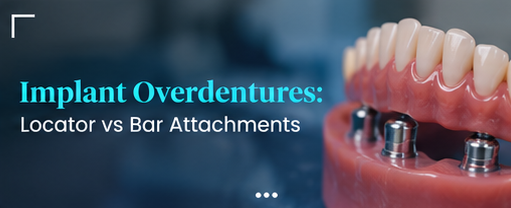
For an edentulous patient with a loose lower denture, an implant supported overdenture can change everything: confident eating, clearer speech, no more adhesive. Since the McGill consensus of 2002, a two implant overdenture has been widely regarded as the minimum standard of care for the edentulous mandible. The big question is how the denture should attach.
Our guide to dental lab dentures covers the denture side of the process, and our dental implant cost page lists component pricing. Swift Lab produces both stud and bar overdentures at our dental laboratory in Ras Al Khaimah.
How an Implant Supported Overdenture Works
Removable by design
The patient removes the denture for cleaning and at night.
Retention vs support
Depending on the number of implants and design, it can be implant retained and tissue supported, or largely implant supported.
Stud Attachments (Locator and Similar)
How they work
Each implant gets a low profile abutment; the denture carries housings with replaceable nylon inserts.
Advantages
Less space needed
Stud attachments suit patients with limited room between the ridge and the opposing teeth.
Easy hygiene and maintenance
Abutments are cleaned with a normal brush, and inserts are changed chairside in minutes.
Angle tolerance
They tolerate moderate implant divergence, and extended range inserts handle more.
Limitations
Inserts wear and commonly need replacing every 6 to 12 months. Divergence or resilient tissue causes uneven wear, and implants aren’t splinted.
Bar Attachments
How they work
A milled titanium or cobalt chromium bar splints the implants, and clips or attachments in the denture engage it.
Advantages
Load sharing
Splinting spreads load, which helps with short implants, soft bone and the maxilla.
Corrects divergence
Bars compensate for implants at very different angles.
High retention
Bars give excellent stability against rotation and lateral movement.
Limitations
Bars need more vertical space, roughly 12 mm or more from tissue to the occlusal plane. Hygiene under the bar is harder, tissue overgrowth can occur, and cost is higher.
Comparison
| Factor | Locator | Bar |
|---|---|---|
| Space needed | Less | More |
| Parallelism | Moderate divergence OK | Corrects major divergence |
| Implants | Usually 2, mandible | 3 to 4+, often maxilla |
| Load | Independent | Splinted |
| Hygiene | Easier | Harder |
| Cost | Lower | Higher |
Mandible vs Maxilla
Mandible
Two canine region implants with studs is the most common, best supported implant supported overdenture design.
Maxilla
Softer bone means four or more implants, often splinted with a bar.
Palateless designs
With enough implant support, a maxillary overdenture can be palateless, which improves taste and speech.
The Planning Mistake Behind Most Remakes
The most common problem isn’t choosing the wrong attachment. It’s finding too late that there’s no room for it. Measure restorative space from the tissue to the planned occlusal plane before committing.
Reinforce the Denture
Overdentures often fracture over the attachments, where acrylic is thinnest. A cast cobalt chromium reinforcement framework greatly reduces the risk.
Workflow
- Plan space, implant positions and attachment
- Take a pick up impression or scan with scan bodies
- Record jaw relations
- Try in the tooth setup
- Check bar passive fit for bar cases
- Process and deliver
- Review retention and tissue
Always include the implant system, platform and abutment heights.
Maintenance
Every implant supported overdenture needs insert replacement, periodic relines, screw checks and professional cleaning.
Frequently Asked Questions
How many implants does a lower overdenture need?
Two is the accepted minimum.
How many for an upper overdenture?
Usually four or more.
Is a bar more retentive than Locator?
Generally yes, but Locators give enough retention for most mandibular cases.
Can it be converted to a fixed bridge later?
Sometimes, with enough well positioned implants.
Conclusion: Plan Space First
The right implant supported overdenture starts with restorative space and implant position, then balances retention against hygiene and cost. Swift Lab makes stud and bar overdentures, milled bars and reinforcement frameworks for all major implant systems.