
Clinically reviewed by: Dr Ahmed Araby
Zirconia has taken over a large part of the crown market, and many clinics now treat it as the default for almost every case. Yet the PFM crown still crosses our bench every week, and for good reason. In the right situations, porcelain fused to metal remains the most predictable restoration a clinic can prescribe, with decades of clinical data behind it.
This guide is written for dentists, prosthodontists and clinic owners across the UAE. It explains where metal ceramic still outperforms newer materials, how it compares with zirconia, the preparation it needs, how to choose the alloy, and what your lab needs to deliver a case that fits the first time.
Key Takeaways for Clinicians
- A porcelain fused to metal crown combines a cast or milled alloy coping with layered porcelain, cemented conventionally.
- Large reviews report five-year survival for metal-ceramic single crowns in the mid to high 90% range, the benchmark other materials are measured against.
- Metal ceramic still wins for long-span bridges, attachment cases, partial denture abutments, and cases where bonding is unreliable.
- Zirconia wins for bruxers needing monolithic strength, limited occlusal space,e and patients who want metal-free restorations.
- PFM preparation needs 1.5 to 2.0 mm occlusal clearance and a clear facial margin design to avoid chipping and grey margins.
- Tell the lab the alloy type, collar design, and any allergies on every prescription.
What Is a PFM Crown?
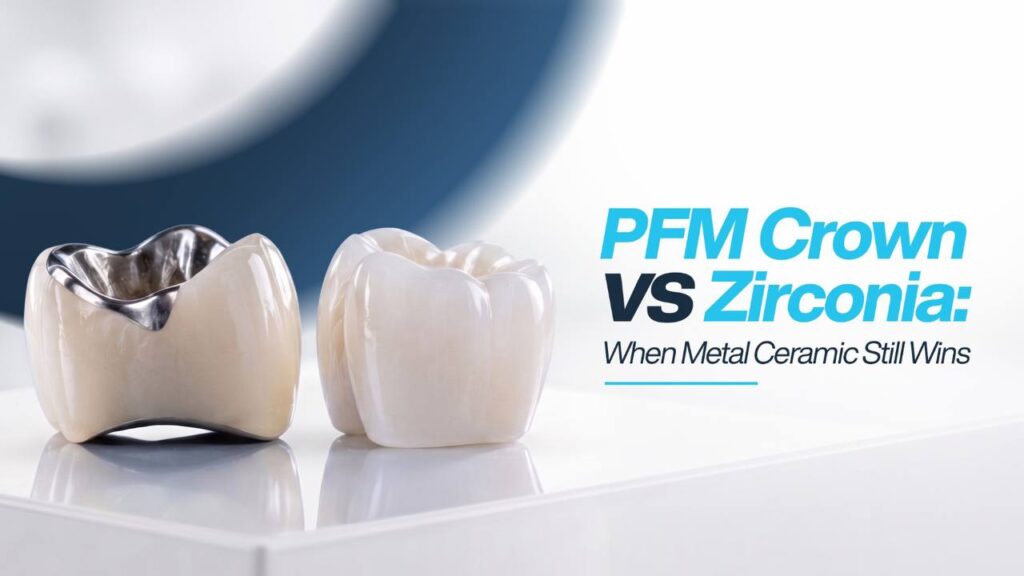
A PFM, or porcelain fused to metal crown, is a full coverage restoration made from a thin metal coping covered with opaque porcelain to mask the metal, then body and incisal porcelain layered to match the natural teeth. The PFM crown meaning is simply porcelain fused to metal: the porcelain is fired directly onto the alloy, creating a chemical and mechanical bond.
How it is made
The coping is cast, milled or printed in the chosen alloy, then oxidised so the porcelain can bond. The ceramist applies opaque, dentine and enamel layers, fires them in stages and finishes with stain and glaze. Fit, contacts and occlusion are checked on the model before dispatch.
Strengths
- A long clinical track record across single crowns and bridges
- High fracture resistance from the metal substructure
- Conventional cementation, so it tolerates less than ideal isolation
- Wide choice of alloys, from economical base metals to high noble gold
Limitations
- Porcelain can chip under heavy load or with thin layers
- A grey margin or metal collar can show if the gingiva recedes
- More tooth reduction than monolithic ceramics
- Less translucency than glass ceramics in the aesthetic zone
What the Evidence Says
The strongest data on metal ceramic crowns comes from large systematic reviews. A review by Sailer and colleagues analysed 67 studies covering 4,663 metal ceramic and 9,434 all ceramic single crowns and estimated a five-year survival of 94.7% for metal ceramic crowns, with lithium disilicate reinforced glass ceramics performing similarly. The same systematic review of single crown survival found that veneered zirconia crowns lost more restorations to veneering porcelain fractures and loss of retention than metal ceramic crowns.
More recent reviews show that monolithic zirconia and monolithic lithium disilicate crowns now reach five-year survival comparable to metal ceramic, largely because monolithic designs avoid chipping. The takeaway for clinics is not that PFM is outdated, but that each material now has clear indications where it performs best.
Five Cases Where Metal Ceramic Still Wins
Long span bridges
For bridges with multiple pontics, especially in the posterior region, a rigid metal framework resists flexing and connector fracture. Connector size limits all ceramic options on long spans, and our guide to dental bridges explains how span length changes material choice.
Crowns carrying precision attachments
Attachments soldered, cast, or laser welded to a metal framework remain the most reliable way to connect fixed and removable prostheses. Metal gives the lab a stable base for precise attachment positioning.
Abutments for partial dentures
Rest seats, guide planes, and undercuts for clasps are easier to build and more durable in metal-ceramic. If you are planning a cast partial denture, surveying the crowns together with the framework gives a far better fit.
Cases where bonding is unreliable
Subgingival margins, short clinical crowns, or poor isolation make adhesive cementation unpredictable. A PFM is cemented conventionally, so it performs well where bonded ceramics would struggle.
When the clinician and patient prefer a proven option
Some patients ask for a conventional crown, and some clinicians have decades of predictable results with metal ceramic. That experience is a valid clinical reason, particularly for posterior crowns outside the smile line.
PFM Crown vs Zirconia: Where Each Material Fits
The PFM vs zirconia crown decision is rarely about which material is better overall. It is about which one suits the tooth, the occlusion, and the patient in front of you.
Where zirconia wins
Monolithic zirconia crowns need less occlusal clearance, do not chip because there is no veneering layer, and suit bruxers and patients with limited space.
For posterior units where strength matters more than layered aesthetics, our article on monolithic zirconia explains when to prescribe it instead of layered zirconia.
Where glass ceramics win
In the aesthetic zone, translucency usually decides the case. Bonded Emax crowns offer the most natural appearance on anterior teeth with good enamel for bonding.
Combining materials in one case
Many full mouth cases use both. A zirconia and PFM crown plan is common when anterior teeth need maximum aesthetics while a long posterior bridge or an attachment case needs a metal framework. Shade matching across materials is manageable when the lab receives the same shade photos for every unit.
A quick comparison
- Strength: both are strong; monolithic zirconia resists chipping, while metal ceramic resists framework fracture on long spans.
- Aesthetics: zirconia avoids grey margins; PFM can match well with a porcelain margin but shows metal if gingiva recedes.
- Tooth reduction: a porcelain-fused-to-metal crown usually needs more reduction than monolithic zirconia.
- Cementation: both can be cemented conventionally, which suits difficult isolation.
- Track record: metal ceramic has the longest clinical history of any crown type.
Clinicians comparing zirconia vs PFM crown options for the same patient should start from the occlusion and span, then weigh aesthetics and budget.
PFM Crown Preparation Guidelines
Adequate, even reduction is the best protection against porcelain chipping.
Occlusal and axial reduction
Aim for 1.5 to 2.0 mm of occlusal clearance on functional cusps and around 1.2 to 1.5 mm of axial reduction on the facial surface, where porcelain covers metal. If clearance is tight, consider metal occlusal or metal lingual coverage rather than thinning the porcelain, or switch to a monolithic material.
Margin design
Use a shoulder or deep chamfer of about 1.0 mm on the facial aspect to give room for porcelain, and a lighter chamfer on the lingual where a metal margin is acceptable. This differs from zirconia crown preparation, which can work with a lighter chamfer all round.
Choosing the collar
- Porcelain margin: porcelain extends to the finish line for the best aesthetics, ideal for visible teeth.
- Metal collar: a thin metal band at the margin, strongest and simplest, best for posterior or non-visible areas.
- Hidden collar: a very thin metal margin placed slightly subgingivally, balancing strength and aesthetics.
Occlusal contacts
Keep centric contacts on porcelain well supported by metal, and avoid placing contacts on the porcelain-metal junction, where stress concentrates and chipping starts.
Choosing the Alloy
Alloy choice affects strength, biocompatibility, aesthetics, and cost.
Base metal alloys
Non-precious nickel-chromium and cobalt-chromium alloys are strong, rigid, and economical, which makes them popular for long span bridges. Cobalt chromium is the safer choice for patients with a known nickel sensitivity.
Noble and high noble alloys. Semi-precious and precious alloys are easier to cast precisely, gentler on margins, and give a warmer tone under porcelain. Our PFM crowns service works withnon-precious, semi-precious, and precious alloys, with precious alloys weighed and priced by weight.
Cost considerations for clinics
Lab fees for metal ceramic depend mainly on the alloy and unit count, while monolithic zirconia pricing is more uniform. Our guide to zirconia crown price explains the factors that drive fees for zirconia, which helps when you present both options to patients.
Tell the lab about allergies.
Always note any metal allergy or sensitivity on the prescription. It changes the alloy we select and can rule out base metals entirely.
What to Send the Lab
Records
- An intraoral scanner file in STL format, or an impression with clear margins
- The opposing arch and a bite registration
- Shade, stump shade,e and photos for any crown in the smile zone
Prescription notes
- Alloy type: non-precious, semi-precious, or precious
- Collar design: porcelain margin, metal collar, or hidden collar
- Any metal occlusal or lingual coverage
- Attachments, rest seats or guide planes for partial denture cases
- Known allergies or sensitivities
How Swift Lab Handles Metal Ceramic Cases
Every case is checked for margins, bite, and shade information as soon as it arrives. Copings are designed with the right thickness for the porcelain, then fitted, layered,d and checked for fit, contacts, ts and occlusion on the model before dispatch. Clinics ordering a PFM crown in Dubai, Sharjah, Abu Dhabi or the northern emirates use our courier collection and digital case submission, so location is never a barrier.
Standard cases of 1 to 3 units are ready in 3 working days and 4 to 10 units in 4 working days, with full mouth and complex cases taking around 7 working days. All restorations carry a one-year warranty against defects in materials and workmanship. You can compare all eight options in our dental crowns department.
Frequently Asked Questions From Dentists and Clinics
Is metal ceramic still worth prescribing?
Yes, for the right indications. Long span bridges, attachment cases, partial denture abutments and situations where bonding is unreliable still favour metal ceramic, and its survival data remain among the strongest of any crown type.
Zirconia crown vs PFM: which is stronger?
Both are strong in different ways. Monolithic zirconia resists chipping and needs less space, while a metal framework resists flexing on long spans. Veneered zirconia has shown more porcelain chipping than metal ceramic in clinical reviews.
How much occlusal clearance does a PFM need?
Plan 1.5 to 2.0 mm on functional cusps. If you cannot achieve it, request metal occlusal coverage or choose a monolithic material rather than accepting thin porcelain.
Why do PFM margins turn grey?
The metal collar or opaque layer becomes visible when the gingiva recedes, or the tissue is thin. A porcelain margin or hidden collar, and correct margin placement, reduce the risk in visible areas.
Which alloy should I choose?
Base metals suit long spans and budget-sensitive cases, while semi-precious and precious alloys offer easier casting, better marginal adaptation, and a warmer tone. Choose cobalt-chromium or a noble alloy for patients with nickel sensitivity.
Can PFM and zirconia crowns be used in the same mouth?
Yes. Mixed material plans are common, and shade matching works well when the lab receives the same shade guide reference and photos for every unit.
What is your turnaround for PFM cases?
Standard cases of 1 to 3 units take 3 working days, and 4 to 10 units take 4 working days. Full mouth and complex cases take around 7 working days, and urgent cases can be arranged on request.
Do you serve clinics outside Ras Al Khaimah?
Yes. We work with clinics in Dubai, Sharjah, Abu Dhabi, Ajman, Umm Al Quwain and Fujairah through courier collection and digital case submission.
The Right Material for the Right Case
Zirconia and glass ceramics have earned their place, but they have not made metal ceramic obsolete. For long spans, attachments, partial denture abutments,s and difficult bonding conditions, the PFM crown remains one of the most predictable restorations a clinic can offer. Choose the material from the case, give the lab the space and information it needs, and every option on your prescription pad will perform as it should. Send us your records and our technicians will help you decide which material suits the case.
References
- Sailer I, Makarov NA, Thoma DS, Zwahlen M, Pjetursson BE. All ceramic or metal ceramic tooth supported fixed dental prostheses? A systematic review of the survival and complication rates. Part I: Single crowns. Dental Materials, 2015.
- A Systematic Review and Meta-Analysis Evaluating the Survival, the Failure and the Complication Rates of Metal Ceramic, Veneered and Monolithic All Ceramic Tooth Supported Single Crowns. PubMed ID 41489982.