
Clinically reviewed by: [Dr Ahmed Araby]
Every week, cases arrive at our Ras Al Khaimah lab with two words on the prescription: “no prep.” Some of them become the most conservative, natural smiles we make all year. Others arrive on models that already tell us, before we have built a single shell, that the final result will look thick and obviously restored. After years of fabricating these restorations for clinics across the Emirates, we have learned that the ceramic is rarely the difference. Case selection is.
This guide is written for dentists, cosmetic dental centres and clinic owners across the UAE. It covers what we see from the bench, what the clinical research actually says, how to select and plan cases, what your lab needs from you, and the questions clinicians ask us most often before sending their first case.
Key Takeaways for Clinicians
- No prep veneers are ultra-thin ceramic or composite shells, usually about 0.2 to 0.5 mm, bonded to enamel with little or no reduction.
- Prescribe them for teeth that need added volume: small, spaced, worn or slightly retroclined teeth with mild discolouration.
- Avoid or modify the plan for proclined or crowded teeth, dark substrates, weak enamel, and unmanaged bruxism.
- Published data show survival comparable to, or better than, conventional veneers, but contour and gingival response need careful design.
- A digital smile design and intraoral mock-up protect both the result and your case acceptance.
- Minimal prep veneers on one or two prominent teeth often outperform a uniform no prep prescription.
- Your lab needs scans, bite, stump shade, photos, and an approved mock-up to deliver predictably.
What Are No Prep Veneers?
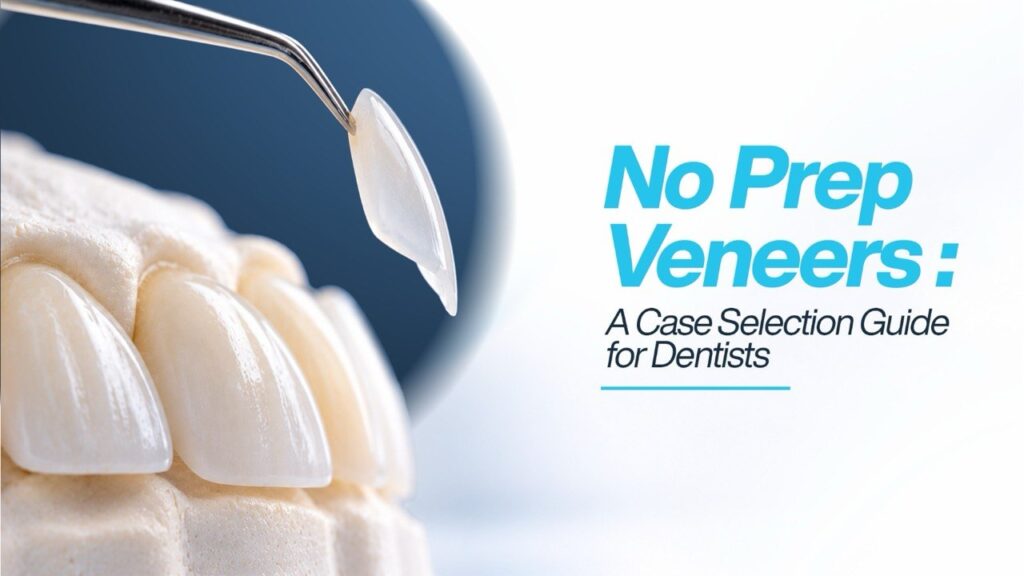
A no-prep veneer is a thin restoration bonded directly onto unprepared, or almost unprepared, enamel. Because no tooth structure is removed, it adds thickness to the facial surface rather than replacing lost tissue. That single fact drives every clinical decision that follows: the tooth must have room to gain volume without looking bulky.
One treatment, many names
Patients and clinics use several labels for the same idea. You will hear prepless veneers, non-prep veneers, no preparation veneers, and, in search data, even “without preparation veneers.” Branded systems such as Lumineers are marketed under their own names. Whatever the label, the clinical question stays the same: can this tooth accept extra thickness and still look natural?
No prep vs minimal prep veneers
True no prep means the enamel is left untouched apart from cleaning and etching. Minimal prep veneers involve light enamel recontouring, usually fractions of a millimetre, to smooth a convexity, define a finish line or create a path of insertion. Both stay within enamel. In our experience, many of the best “no prep” results actually involved a small amount of selective adjustment at the incisal edge or margins.
Positioning the Treatment in Your Clinic
Patients arrive having already compared options online, so the clinics with the highest case acceptance are the ones that can explain clearly where this treatment fits.
No prep vs conventional porcelain veneers
Conventional preparation usually removes around 0.5 mm of enamel, which gives the ceramist room to build thickness for colour change and alignment without adding bulk. Prepless veneers preserve that enamel but leave less room to mask a dark substrate or correct position. Present it as a trade-off between conservation and correction, and let the mock-up show which one the case needs.
Prepless veneers vs branded systems
Branded systems such as Lumineers are one type of ultra-thin veneer, not a separate treatment category. A capable dental laboratory can fabricate comparable ultra-thin restorations in feldspathic porcelain or lithium disilicate to your design, which gives your clinic more control over material choice, shade, and lab fees.
Ceramic shells vs composite bonding
Direct composite bonding suits single-visit, lower fee treatment plans but stains and wears sooner. Ceramic shells carry a higher fee and a longer aesthetic life. For price-sensitive patients, lab-made indirect composite veneers give your clinic a middle-tier option without chairside layering time.
What the Research Says
Evidence matters here because marketing claims around this treatment often run ahead of the data.
Survival rates
A prospective study by Smielak and colleagues followed 186 porcelain veneers in 35 patients for a mean of nine years and reported that the no-prep and minimally invasive group survived better than conventionally prepared veneers. You can read the full nine-year comparative study in Clinical Oral Investigations.
A 2024 narrative review by Alghazzawi in the Journal of Functional Biomaterials found that veneers generally exceed 90% survival beyond ten years, that the amount of preserved enamel plays a major role in success, and that glass ceramic veneers with minimal or no preparation showed the highest survival. The veneer survival and failure review also identified fracture as the main failure mode, followed by debonding and colour change.
Gingival health and contour
A seven-year retrospective study by Mihali and colleagues of 170 feldspathic veneers found no significant survival difference between prepared and no prep teeth, but the no prep group scored worse for periodontal response and anatomical form. The seven-year feldspathic veneer study is a useful reminder that a veneer can survive and still be a poor restoration if its contour traps plaque.
Where the evidence is still thin
A 2018 systematic review by Zarone and colleagues concluded there was not yet enough randomised data to make a definitive clinical statement about the technique, and recommended cautious case selection. Most published studies are small, single-operator, and retrospective, so we treat the positive survival data as encouraging rather than conclusive.
Who Is a Good Candidate?
The quickest test is a single question: does the tooth have room to grow outward?
Strong indications
These are the cases where no prep veneers tend to look their best:
- Small or peg-shaped lateral incisors
- Diastemas and black triangles that need closing
- Teeth that are slightly retroclined or palatally positioned
- Worn or short incisal edges that need length restored
- Mild discolouration, roughly within one or two shades of the target
- Healthy enamel and stable, healthy gums
When to say no, or plan differently
In these situations, consider orthodontics first, a minimal prep design, or a different restoration:
- Teeth that are already proclined or labially positioned
- Significant crowding or rotations
- Dark or deep intrinsic staining that a thin shell cannot mask
- Large existing composites or crowns that leave little enamel to bond to
- Active caries or periodontal disease
- Heavy, unmanaged bruxism
The shade change rule of thumb
A one- to two shade improvement is realistic with ultra-thin ceramics, two to four shades is uncertain, and anything beyond that usually needs more thickness and therefore some reduction. Always send the stump shade. Without it, the ceramist is guessing how much of the underlying tooth will show through a shell only a few tenths of a millimetre thick.
What We See at the Bench: Why Cases Disappoint
When a case comes back for a remake, the cause is almost always one of these four:
Volume added to the wrong teeth
The most common problem is a uniform “no prep for every tooth” prescription. Prominent canines or a slightly flared central incisor cannot take extra thickness without looking bulky, even if the lateral incisors beside them are perfect candidates.
Missing stump shade or photos
Ultra-thin ceramic is partly translucent, so the colour of the tooth underneath becomes part of the final shade. Without a stump shade and retracted photos, the result can look grey or too opaque.
Overcontoured margins
With no finish line, the ceramic must blend into enamel at a feather edge. A small ledge at the gingival third is easy to miss on a model and is a classic cause of plaque retention and inflamed gums.
No mock-up approval
When the patient sees the new smile for the first time at try-in, surprises happen and chair time disappears into adjustments. A mock-up signed off in advance removes most of that risk and protects the clinic if expectations change later.
Plan the Volume Before You Promise the Smile
Start with a digital smile design
Before the treatment plan is presented, the final shape should already be planned from photos and scans. A digital smile design shows straight away whether added volume will look natural or whether some teeth need adjustment to stay within the arch.
Test drive it with a mock-up
A wax-up transferred to the mouth as a mock-up is the most honest test. If the mock-up looks bulky, the final veneers will too. Our guide to digital smile design steps for case acceptance explains how to use this appointment to align expectations.
Decide where selective reduction is needed
The mock-up often shows that most teeth are fine as they are, while one or two need minor enamel adjustment. Mixing no-prep and minimal prep veneers in the same arch is normal, and it produces a more natural result than forcing every tooth into one protocol.
Choosing the Right Material
Feldspathic porcelain
Layered on a refractory die, feldspathic veneers can be made extremely thin while keeping deep, lifelike translucency. They are often the first choice for the thinnest shells and maximum aesthetics, though they need careful handling before bonding.
Lithium disilicate
Pressed or milled Emax veneers offer a higher strength margin with a natural look and suit cases where slightly more thickness is acceptable.
If you are comparing ceramics more broadly, our article on zirconia vs Emax explains why glass ceramics usually win for veneers.
When only part of the tooth needs help
For a single chipped corner or a small incisal defect, partial veneers restore only the damaged area and leave the rest of the enamel untouched.
What to Send the Lab
Thin restorations leave no room for missing information.
Records
- An intraoral scan in STL format, or impressions of both arches
- A bite registration
- Any approved mock-up or wax-up
If you scan in the clinic, our intraoral scanner tips help avoid the margin and contact errors that lead to remakes.
Shade and photos
- The target shade and the stump shade
- Full face, retracted and close-up smile photos, ideally with a shade tab in frame
Aesthetic notes
Tell us where you want length, where contacts should close, and whether any teeth were adjusted. If you are choosing a partner for aesthetic work, our guide to the ideal dental lab lists what to check first.
Bonding, Finishing and Aftercare
Bonding to enamel
Clean, etch, and bond following the cement manufacturer’s protocol. Research on thin veneers supports light-cure resin cement for better long-term colour stability where thickness allows.
Finishing the margins
Polish the ceramic-to-enamel junction at try-in until it cannot be felt with an explorer. This step does more for long-term gum health than any other.
Protecting the result
Fracture risk rises with parafunction, so build a night guard into the treatment plan and fee for every patient who clenches or grinds.
How Swift Lab Handles No Prep Cases
Every case starts with a technician review of the scans and photos, so we can tell you early whether a pure no-prep approach will give a natural emergence profile or whether minimal reduction on certain teeth will look better. Veneers are layered, pressed, or milled in-house and checked under controlled light before they leave the lab on accurate models with clear notes.
Standard cases of 1 to 3 units are ready in 3 working days, 4 to 10 units in 4 working days, and full mouth cases in around 7 working days, with urgent cases arranged on request. All restorations carry a one-year warranty against defects in materials and workmanship. The full protocol and case submission steps are on our no prep veneers service page.
If a case needs more thickness or a different ceramic, you can compare all five options on our dental veneers page. We are based at Julphar Business Tower, Al Nakheel, Ras Al Khaimah, and work with clinics in Dubai, Sharjah, Abu Dhabi, Ajman, Umm Al Quwain and Fujairah through courier collection and digital case submission.
Frequently Asked Questions From Dentists and Clinics
These are the questions clinicians and clinic managers ask us most often before sending a case.
How thin can a lab make no prep veneers?
Feldspathic porcelain on a refractory die can be made down to roughly 0.2 to 0.3 mm in the cervical and middle thirds, with slightly more at the incisal edge. Pressed or milled lithium disilicate usually needs a little more thickness. Tell us the space available on the mock-up, and we will advise which material fits.
Which material should I prescribe for no prep veneers?
Prescribe feldspathic when you need the thinnest shells and the highest translucency, especially on small or spaced teeth. Prescribe lithium disilicate when you have slightly more space and want a higher strength margin. If you are unsure, send the records and leave the material choice to our technician for review.
Do I need a finish line?
Not always. True no-prep shells end on a feather edge directly on enamel. If the emergence profile looks bulky on the wax-up, a light chamfer in enamel at the cervical third gives the ceramist a defined margin and a better gingival contour.
Can I mix no prep and minimal prep in one case?
Yes, and it is often the best plan. Prominent teeth receive selective enamel reduction through the mock-up while the rest stay unprepared. Mark each tooth clearly on the prescription so the lab designs thickness accordingly.
Can they mask a dark tooth?
Only within narrow limits. A change of one or two shades is realistic, while a darkened root-treated tooth or tetracycline staining usually needs more ceramic thickness and therefore some preparation. Always send a stump shade so we can judge the substrate.
How do I avoid a bulky result?
Plan from the face, not the model. Approve a digital smile design, test it with an intraoral mock-up, reduce any teeth that look full, and send photos of the approved mock-up. Most bulky cases we see were never mocked up.
What does the lab need to start a case?
An STL scan or impressions of both arches, a bite registration, target and stump shades, full face, retracted, and close-up photos, and the approved mock-up or wax-up. Incomplete records are the most common reason for delays.
Can the lab assess suitability before I commit the patient?
Yes. Send scans and photos first, and our technicians will review whether a pure no-prep approach will give a natural emergence profile, or whether some teeth need minimal reduction, before you present the final plan.
Which cement do you recommend?
For thin, translucent shells, a light-cure resin cement is generally preferred because it supports long-term colour stability. Follow the cement manufacturer’s etching and silane protocol for the ceramic you prescribed.
How do survival rates compare with conventional veneers?
Published studies report survival similar to, or higher than, conventional veneers over seven to ten years when bonded to enamel. The trade-off reported in the literature is a weaker periodontal response when contours are not controlled, which is why margin design matters.
How should we describe reversibility during consent?
Describe the treatment as minimally invasive and largely reversible rather than fully reversible. The enamel is etched and bonded, so it is never identical to untouched enamel after removal.
Should I place no-prep veneers on patients who grind?
Only when parafunction is managed. Fracture is the leading cause of failure in thin veneers, so include a custom night guard in the treatment plan and fee.
What is your turnaround for veneer cases?
Standard cases of 1 to 3 units are ready in 3 working days, 4 to 10 units in 4 working days, and full mouth cases in around 7 working days. Urgent cases can be arranged on request.
Do you work with clinics outside Ras Al Khaimah?
Yes. We serve clinics in Dubai, Sharjah, Abu Dhabi, Ajman, Umm Al Quwain and Fujairah through courier collection and digital case submission.
What warranty do restorations carry?
All Swift Lab restorations carry a one-year warranty against defects in materials and workmanship.
The Best No Prep Case Is the Right Case
Demand for drill-free veneers keeps growing across the UAE, and with the right case, no-prep veneers deliver some of the most conservative and natural smiles a clinic can offer. Success does not depend on the ceramic alone. It depends on selecting teeth that have space to gain volume, testing the plan with a mock-up, and being willing to switch to minimal prep where it looks better. Send us your records before you commit, and our technicians will tell you honestly which approach the case supports.