
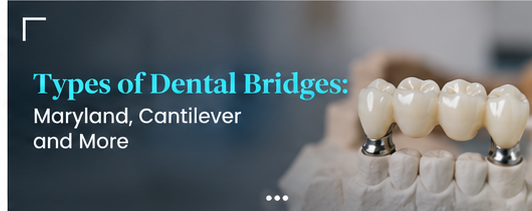
Implants haven’t made bridges obsolete. The four main types of dental bridges (traditional, cantilever, Maryland and implant supported) are still faster, often more affordable, and last for decades when the design suits the case. When it doesn’t, the lab sees the results: fractured connectors, Maryland wings debonded on one side, pontics that trap food.
Material choice shapes every bridge. Our porcelain vs zirconia crowns article covers the trade-offs, and zirconia vs E-max explains why E.max bridges have tighter limits. For implant bridges, see our dental implant cost page.
The Types of Dental Bridges at a Glance
| Bridge | Support | Prep | Typical use |
|---|---|---|---|
| Traditional | Crowns on both sides | Full crown preps | Most short spans |
| Cantilever | One abutment | One crown prep | Missing lateral incisor |
| Maryland | Bonded wing | Minimal, in enamel | Single missing incisor |
| Implant supported | Implants | None on teeth | Longer spans |
Traditional Bridges
When to choose them
Choose a traditional bridge when the abutments need crowns anyway, the span is short, or implants aren’t suitable.
Evaluating abutments
Check periodontal support, crown to root ratio, root form, endodontic status and parallelism.
Materials and connector size
Zirconia
Monolithic 3Y zirconia needs about 9 mm² connectors for three unit posterior bridges, and more for longer spans.
E.max
E.max is limited to three units ending at the second premolar, with connectors of about 12 mm² anterior and 16 mm² posterior.
PFM
PFM remains reliable for long spans because metal is strong in thin sections.
Cantilever Bridges
Best indication
The classic case is a lateral incisor supported from a strong canine.
When to avoid
Avoid posterior cantilevers under heavy forces, where the pontic acts as a lever.
Design tips
Keep the pontic slightly small, out of heavy contact, and make the abutment prep as retentive as possible.
Maryland Bridges
Why they’re the most conservative
A pontic is attached to a thin wing bonded to the neighbouring tooth, with minimal preparation in enamel.
Single wing vs two wings
Single wing designs perform better. With two wings, one often debonds while the other holds, trapping plaque unnoticed.
Prep and bonding
Keep the prep in enamel, add a small rest seat, allow 0.5 to 0.7 mm wing clearance, and for zirconia wings air abrade and use an MDP primer.
Implant Supported Bridges
These replace multiple teeth without preparing natural teeth. Screw retained designs are retrievable and avoid excess cement; cemented designs can look slightly better where an access hole would show.
Pontic Design
| Pontic | Ridge contact | Best for |
|---|---|---|
| Modified ridge lap | Facial only | Most cases |
| Ovate | Shaped socket | Aesthetic anterior |
| Sanitary | None | Lower posterior |
| Conical | Point contact | Narrow ridges |
Which Bridge for Which Case
| Situation | Suggested bridge |
|---|---|
| Single missing incisor, unrestored neighbours | Single wing Maryland |
| Missing lateral incisor, strong canine | Cantilever |
| Posterior span, restored abutments | Traditional zirconia or PFM |
| Healthy neighbours, good bone | Implant bridge |
The Design Mistakes Labs See Most
Connector fracture
This is usually from insufficient connector height. Check the space available before choosing a ceramic.
Debonding
Short, overtapered preps and two wing Maryland designs are the usual causes.
Porcelain chipping
Use monolithic zirconia for posterior bridges.
What to Send the Lab
- Full arch scans or impressions and a bite
- Abutment and pontic tooth numbers
- Material or priorities, and pontic design
- Shade with photos, and stump shade for translucent materials
Frequently Asked Questions
Which types of dental bridges are strongest?
Monolithic 3Y zirconia and PFM traditional bridges.
How long do Maryland bridges last?
Many years when single wing and bonded to enamel.
Can E.max be used for bridges?
Only three unit spans ending at the second premolar.
Is an implant bridge always better?
No. Traditional bridges are faster and suit abutments that need crowns anyway.
Conclusion: Match the Bridge to the Case
Each of the types of dental bridges has a clear place, and choosing the right one is what makes it last. Swift Lab produces zirconia, E.max, PFM, Maryland and implant bridges, typically within 3 to 5 working days, at our dental laboratory in Ras Al Khaimah.