
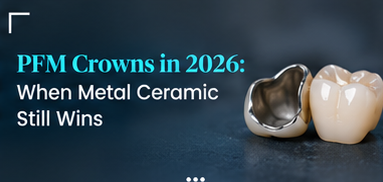
Twenty years ago, the PFM crown was the answer to almost every crown question. Today, zirconia has taken over most single crown cases, and some clinicians have stopped prescribing metal ceramic altogether. That’s understandable, but it’s also a mistake. Porcelain fused to metal still has a clear place in modern dentistry, and in certain cases it’s simply the better restoration.
Before we get into those cases, it’s worth understanding how the materials compare. Our porcelain vs zirconia crowns article covers the basics, and our zirconia crown price guide shows why the cost gap between the two has almost disappeared. For cases involving removable prosthetics, our guide to dental lab dentures is also relevant.
What Makes a PFM Crown Different
A PFM crown has a cast or milled metal substructure (the coping) with porcelain fused over it. The metal provides strength and precise fit; the porcelain provides tooth coloured aesthetics.
Strengths
- Decades of clinical evidence. Few restorations have a longer track record.
- Rigid, strong frameworks that perform well in thin sections and long spans.
- Versatility. Metal can carry attachments, rest seats and milled features that ceramics handle less easily.
Weaknesses
- Porcelain chipping, particularly under heavy loads or poorly supported porcelain.
- Grey margins. The metal can show as a dark line at the gum, especially with thin tissue or recession.
- More reduction than monolithic zirconia.
5 Cases Where a PFM Crown Still Wins
1. Long span bridges
As spans get longer, ceramic connectors need to get bigger, and there isn’t always room. A metal framework is stiff and strong in thinner sections, which makes it a reliable choice for long span bridges where zirconia connectors would be too bulky.
2. Crowns carrying precision attachments
When a crown needs to carry a precision attachment for a removable partial denture, metal is the natural choice. Attachments can be cast into or soldered to the framework with excellent accuracy.
3. Abutments for partial dentures
A crowned tooth that will support a partial denture needs rest seats, guide planes and sometimes milled shoulders. These features are straightforward to build into a metal framework and very durable in use.
Why this matters for the partial
If the crown’s contours aren’t designed for the partial, the clasps and rests won’t fit well, and the partial loses support. Planning the PFM crown and the partial together gives both a better result.
4. Combined fixed and removable cases
Complex rehabilitations that mix crowns, bridges and removable prosthetics often benefit from consistent metal frameworks, which make the whole system easier to design and adjust.
5. When the clinician’s experience favours it
Clinical familiarity counts. A clinician who has placed thousands of successful metal ceramic crowns, with established prep and cementation protocols, will often get excellent results with them.
Where Zirconia Wins Instead
For most single crowns today, monolithic zirconia is the better choice. It needs less reduction, has no metal margin, doesn’t chip, and is at least as strong. Zirconia also wins in limited interocclusal space, for bruxers, and for patients who prefer metal free restorations.
Prep Requirements for a PFM Crown
Metal ceramic needs room for both the metal and the porcelain.
| Area | Reduction |
|---|---|
| Occlusal (porcelain covered) | 1.5 to 2.0 mm |
| Facial | 1.2 to 1.5 mm |
| Lingual (metal collar) | around 0.5 mm |
Margin design
Facial margins
A shoulder or heavy chamfer on the facial gives room for porcelain. If aesthetics matter, ask for a porcelain butt margin, which replaces the visible metal collar with porcelain right to the margin.
Lingual margins
A lighter chamfer with a metal collar is usually fine where it can’t be seen, and it conserves tooth structure.
Occlusal contacts
Tell the lab whether you want occlusal contacts on metal or porcelain. Metal occlusal surfaces are more durable and kinder to opposing teeth, which is useful for bruxers who still need a PFM restoration.
Choosing the Alloy
Base metal alloys
Cobalt chromium alloys are strong, rigid and economical. Nickel free options avoid concerns for patients with nickel sensitivity.
Noble and high noble alloys
These contain gold, palladium or platinum. They’re more expensive but offer excellent castability, fit and biocompatibility, and many clinicians prefer them for long term restorations.
Tell the lab about allergies
Always note any known metal allergy on the prescription so the lab can select a suitable alloy.
PFM Crown vs Zirconia: Quick Comparison
| Factor | PFM crown | Monolithic zirconia |
|---|---|---|
| Strength | High | Very high |
| Chipping risk | Moderate | Very low |
| Reduction needed | More | Less |
| Grey margin risk | Yes | No |
| Long span bridges | Excellent | Limited by connector size |
| Attachments and rest seats | Excellent | Possible but limited |
What to Send the Lab
- Scans or impressions of the prep, opposing arch and bite
- Alloy preference or allergy information
- Margin design, including whether you want a porcelain butt margin
- Occlusal contact preference: metal or porcelain
- Shade and photos with shade tabs
- For partial denture abutments: the partial design, rest seat positions and path of insertion
Frequently Asked Questions
Is the PFM crown outdated?
Not outdated, but no longer the default. It remains the best option in specific situations such as long spans and crowns supporting partial dentures.
Why does a PFM crown show a grey line at the gum?
The metal margin or collar can show through thin gum tissue or become visible after recession. A porcelain butt margin reduces this.
Is a PFM crown stronger than zirconia?
Monolithic zirconia is stronger as a single crown. PFM’s advantages lie in long spans, attachments and partial denture support.
How long does a PFM crown last?
Well made PFM crowns commonly last 10 to 15 years or more, backed by decades of clinical data.
Conclusion: The Right Tool for the Right Case
Zirconia has earned its place as the default crown, but the PFM crown remains the better restoration for long spans, attachments and partial denture abutments. Choosing between them case by case gives patients the best result. Swift Lab produces PFM, zirconia and E.max restorations, so we can help you choose the right one for every case.