
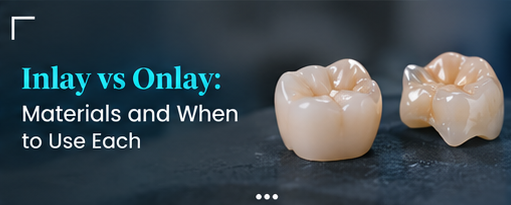
Inlays and onlays sit in a sweet spot between a large filling and a full crown. They preserve far more tooth than a crown, and they outperform big direct fillings for strength, contacts, and wear. The inlay vs onlay decision comes down to one main question: do the cusps need protecting?
Most bonded inlays and onlays today are made from glass ceramics. Our comparison of zirconia vs E-max explains why lithium disilicate usually wins for bonded restorations, and our guide to the ideal dental lab covers what to look for in a partner for adhesive work.
Inlay vs Onlay: The Basic Difference
Inlay
An inlay sits entirely within the cusps of the tooth, replacing tooth structure between them.
Onlay
An onlay extends over one or more cusps, covering and protecting them.
Overlay and endocrown
An overlay covers all the cusps. An endocrown extends into the pulp chamber of a root treated tooth for retention. Both are extensions of the onlay concept.
When to Choose an Inlay
Intact, sturdy cusps
An inlay suits teeth whose cusps are thick and healthy.
Moderate cavity size
When the cavity is moderate and the isthmus is narrow, an inlay restores the tooth conservatively.
Replacing large composites
Large composite fillings can struggle with contacts, marginal leakage and polymerisation shrinkage. An inlay made outside the mouth avoids these problems.
When to Choose an Onlay
Weakened cusps
When a cusp is thin, cracked or undermined, covering it protects the tooth against fracture.
The isthmus rule of thumb
When the isthmus is wider than roughly half the distance between the cusp tips, or cusp walls are thin, cusp coverage is usually the safer choice.
Root treated teeth
Root treated posterior teeth benefit from cusp protection. An onlay or endocrown can often save more tooth than a full crown.
Cracked tooth symptoms
Covering the cusps can stabilise teeth with crack related symptoms.
Material Options
| Material | Strengths | Considerations |
|---|---|---|
| Lithium disilicate (E.max) | Strong, aesthetic, bonds well | Needs about 1.5 to 2.0 mm thickness |
| Composite or hybrid ceramic | Kind to opposing teeth, repairable | Wears more over time |
| Zirconia | Very strong | Harder to bond; used less often |
| Gold | Outstanding longevity and fit | Aesthetics, cost |
Why lithium disilicate leads
It combines good strength with the ability to be etched and bonded, and it matches tooth colour beautifully. For most inlay vs onlay cases, it’s our first recommendation.
Preparation Rules for Ceramic
Walls and taper
Walls should diverge slightly toward the occlusal, with no undercuts. Block out any undercuts with composite rather than removing tooth structure.
Internal angles
Round all internal angles to reduce stress in the ceramic and help the lab reproduce the prep accurately.
Margins
Use butt joint margins with no bevels. Bevels create thin ceramic edges that chip.
Cusp reduction for onlays
Reduce covered cusps by about 1.5 to 2.0 mm to give the ceramic enough thickness.
Bonding Protocol
Isolation
Rubber dam isolation is strongly recommended. Contamination is the enemy of adhesive restorations.
Preparing the ceramic
Etch lithium disilicate with hydrofluoric acid for the manufacturer’s recommended time, then apply silane.
Preparing the tooth
Etch, apply adhesive and cement with a resin cement suited to the restoration’s thickness.
What to Send the Lab
- A clear scan or impression of the prep
- The opposing arch and a bite
- Shade with photos
- Material preference
- Notes on cusp coverage or special design needs
Frequently Asked Questions
Inlay vs onlay: which lasts longer?
Both last well when chosen correctly. An onlay is more durable on teeth with weakened cusps.
Is an onlay better than a crown?
When enough healthy structure remains, an onlay is more conservative and bonds well.
Can inlays and onlays be made from a digital scan?
Yes. Intraoral scans work very well for inlays and onlays.
Do onlays need rubber dam?
Rubber dam is strongly recommended for reliable bonding.
Conclusion: Protect Cusps, Preserve Tooth
The inlay vs onlay choice depends on cusp strength. Protect weakened cusps with an onlay, restore sturdy teeth conservatively with an inlay, and bond carefully under isolation. Swift Lab produces lithium disilicate and composite indirect restorations for clinics across the UAE.